25 American Traditional Sacred Heart Tattoo Ideas With Bold Details
American traditional sacred hearts hit hard — thick black outlines, solid saturated color, and a limited palette that has aged beautifully on skin for a century. These designs celebrate the bold: no whispering lines, no tentative shading, just confident iconography built to last decades.
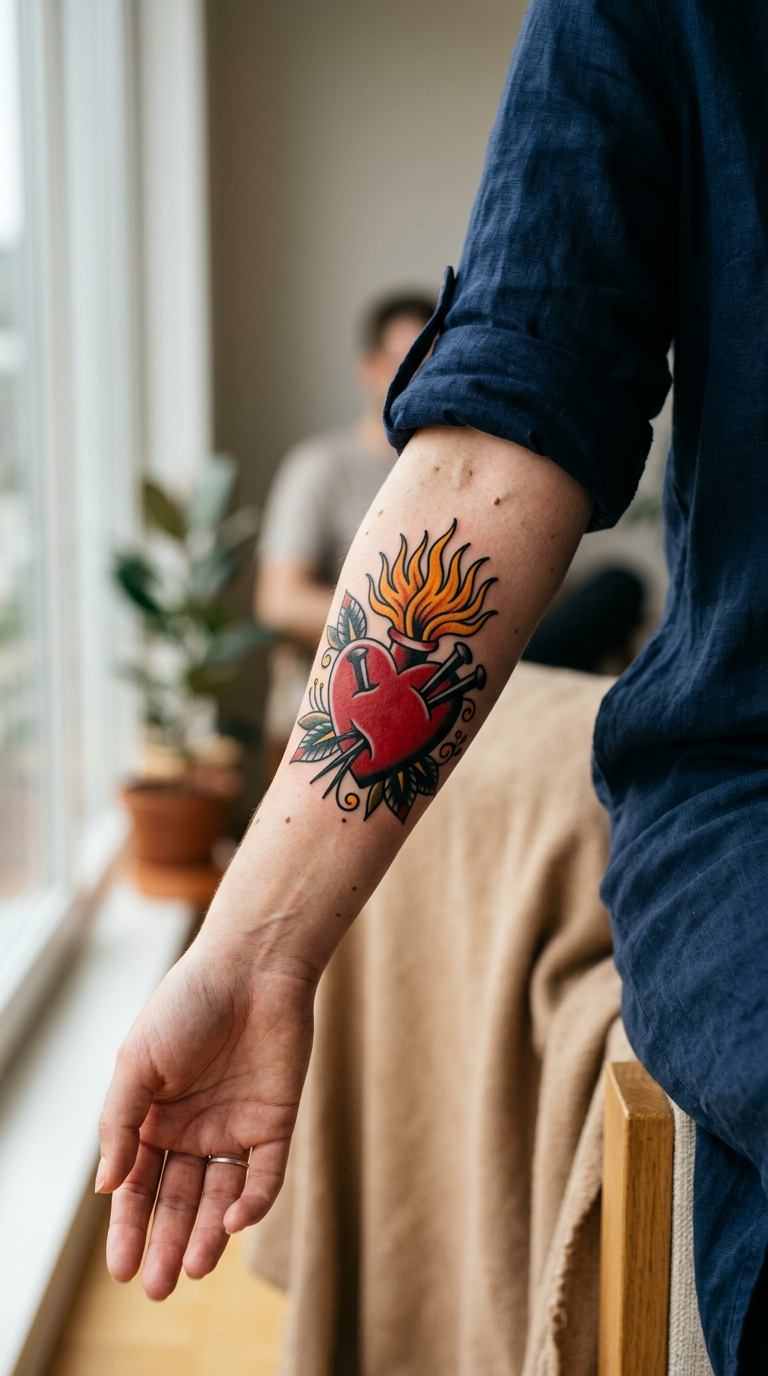
Bold Red Sacred Heart
A heart in unapologetic solid red, outlined in heavy black, flames in yellow and orange. On the forearm, it is a declaration — visible, vivid, and built like a brick.
Red saturation is the entire game. American traditional red should look wet with color. Ask your artist about saturated red packing — multiple careful passes build that lacquered depth.
This is a mid-range piece. Expect one to two hours.
Placement tip: the outer forearm is traditional territory — flat, prominent, and historically where this style lives.
Meaning idea: the bold red heart is devotion at full volume — no hedging, no subtlety. It suits the wearer who means exactly what the symbol says.

American Traditional Dagger Heart
A heavy dagger with a wrapped handle drives through the heart — bold shapes, zero delicacy. On the bicep, the design’s weight matches the muscle.
Handle wrapping detail adds craft. Traditional dagger handles often show cord or tape wraps. Ask your artist about handle wrap detailing — the texture breaks up the bold shapes nicely.
This is a mid-range piece. Expect one to two hours.
Placement tip: align the dagger vertically with the bicep. The bold composition calls for the arm’s full length to breathe.
Meaning idea: this is the heartbreak tattoo of the American tradition — love and loss in the boldest possible lines. It wears its history on its sleeve, literally.

Sacred Heart with Bold Roses
Enormous traditional roses — red petals, yellow centers, black whip-shaded leaves — crowd around the heart. On the upper arm, the composition fills every inch.
Rose scale is the statement. American traditional roses are drawn big and unapologetic. Ask your artist about oversized rose composition — timid roses dilute the style.
This is a mid to larger piece. Expect two hours. Big roses are labor-intensive.
Placement tip: let the design wrap the arm’s circumference. Traditional sleeves are built from pieces exactly like this.
Meaning idea: bold roses with the sacred heart — love, beauty, and devotion at maximum saturation. This is the opposite of subtle, and proud of it.
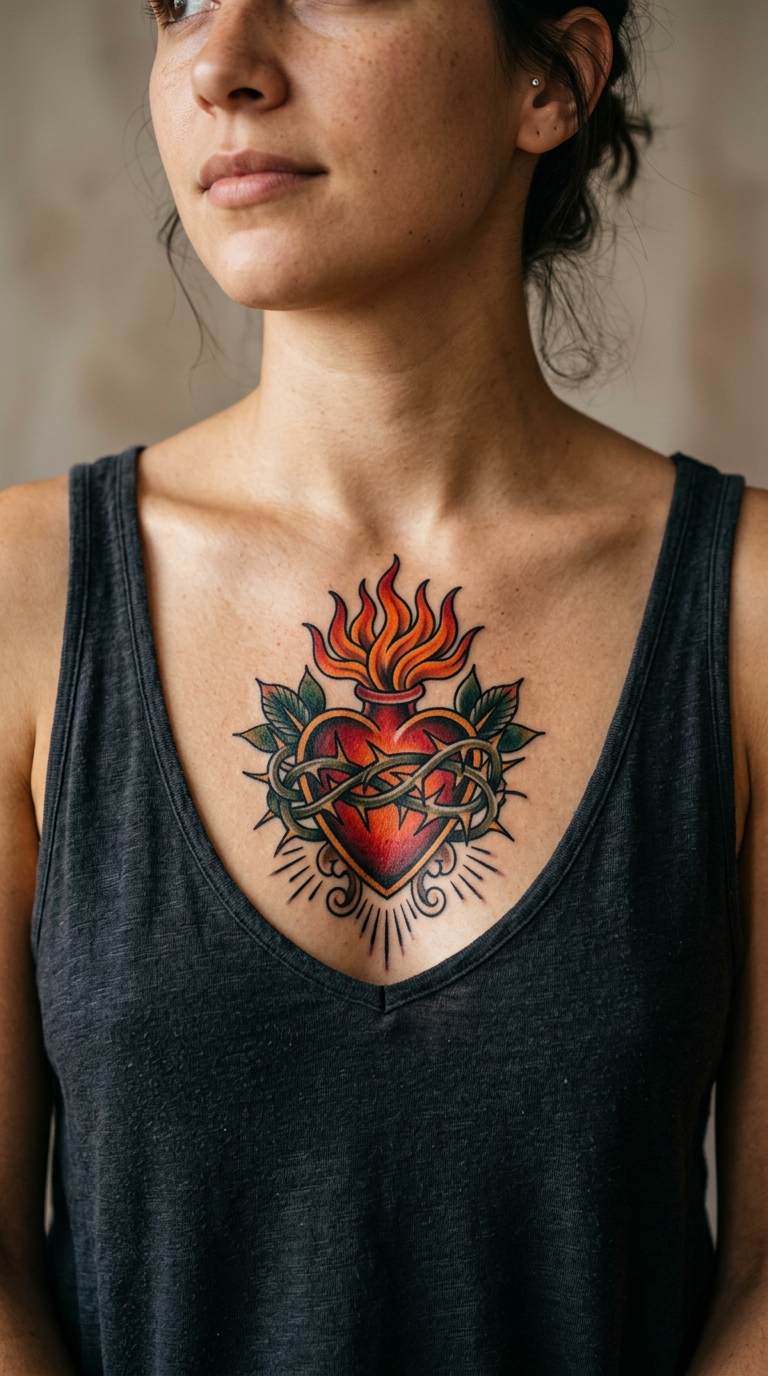
Thorns and Flames Classic
Thick thorn branches and chunky flame tongues in the classic palette — black, red, yellow, green. On the chest, centered, it has the gravity of a badge.
Shape boldness throughout is mandatory. Every element — thorn, flame, heart — must match in visual weight. Ask your artist about consistent bold shapes — one delicate element would betray the style.
This is a mid-range piece. Expect two hours.
Placement tip: center it on the sternum with room around it. Bold designs need negative space to punch against.
Meaning idea: thorns and flames in full traditional dress — suffering and passion drawn with total confidence. The style itself becomes part of the meaning.

Sacred Heart with Traditional Banner
A wide ribbon banner in the classic style — bold outline, simple folds, shaded underside. On the forearm, the banner’s breadth anchors the composition.
Banner simplicity is traditional virtue. No fussy drapery — clean curves and confident shading. Ask your artist about classic banner construction — the traditional scroll has a specific, learnable architecture.
This is a mid-range piece. Expect one to two hours.
Placement tip: keep the banner horizontal across the forearm’s flat. Its blank face is an invitation — add lettering later or never.
Meaning idea: the traditional banner is a dedication in waiting — the heart presented like a gift with a card to be written. Bold, blank, full of possibility.

Sacred Heart and Sparrow
A plump traditional sparrow perches above the heart — blue back, red breast, bold as a postage stamp. On the shoulder, the bird’s compact shape nests perfectly.
Sparrow plumpness is the style. Traditional birds are round and cheerful, never sleek. Ask your artist about classic bird proportions — the roundness is what makes it read as traditional.
This is a mid-range piece. Expect one to two hours.
Placement tip: the shoulder cap gives the bird a natural perch. Angle it slightly forward so it reads from the front.
Meaning idea: the sparrow — the sailor’s companion — with the sacred heart says devotion travels with you. Wherever you roam, the heart comes along.

Black and Grey Traditional Heart
The traditional design stripped to black and grey — bold outlines, whip shading, no color at all. On the calf, the monochrome graphic hits with poster-like force.
Grey wash control defines the style. Traditional grey work uses distinct tones, not smooth gradients. Ask your artist about traditional grey wash tones — the stepped shading is the aesthetic.
This is a mid-range piece. Expect one to two hours.
Placement tip: the calf’s smooth surface shows bold blackwork cleanly. This design wants to be seen — do not hide it.
Meaning idea: black and grey traditional is devotion in its starkest form — no color to soften the statement. Solemn, graphic, unforgettable.

Sacred Heart with Stars
Bold nautical stars — five-pointed, two-tone, outlined heavy — scatter around the heart. On the thigh, the star field has room to spread like a night sky.
Star crispness is everything. Nautical stars live on sharp points and clean color splits. Ask your artist about crisp star points — rounded or wobbly points ruin the graphic snap.
This is a mid to larger piece. Expect two hours. Each star is a small precision project.
Placement tip: scatter the stars asymmetrically around the heart — a studied randomness, like constellations. Too even looks patterned.
Meaning idea: stars are guidance — the heart as something to navigate by. Paired with the sacred heart, they say devotion is your north star.

Flaming Heart with Cross
The cross planted firmly in chunky flames above a bold heart — the complete traditional emblem. On the back of the arm, it is a classic spot with vintage appeal.
Flame chunkiness suits the style. Traditional flames are thick tongues, not wispy trails. Ask your artist about bold flame tongues — each flame should be a solid, readable shape.
This is a mid-range piece. Expect one to two hours.
Placement tip: the back of the upper arm is a traditional sleeper spot — visible when you want it shown, hidden otherwise.
Meaning idea: this is the sacred heart as generations of traditional artists have drawn it — the canon, honored. Choosing it connects you to a living lineage.

Sacred Heart Medallion Bold
The heart locked inside a heavy rope-twist medallion frame — like a sailor’s badge. On the chest, the circular badge has real presence.
Rope twist rendering is the detail. The frame should read as twisted cord, not a plain circle. Ask your artist about rope twist shading — alternating light and dark segments sell the twist.
This is a mid-range piece. Expect one to two hours.
Placement tip: center the medallion on the upper chest. The badge format demands symmetrical placement — measure twice.
Meaning idea: the medallion frames the heart as an honor — devotion as something earned and displayed. It is the most badge-like, declarative design here.

Sacred Heart with Snake
A bold snake coils around the heart — temptation wrapped around devotion, the eternal tension. On the forearm, the coil follows the arm’s length dramatically.
Snake coil dynamics make the piece. The body should wrap with purpose, head raised. Ask your artist about coil composition flow — the snake’s path should lead the eye around the heart, not tangle it.
This is a mid to larger piece. Expect two to three hours. Snakes are all body — lots of scales, lots of time.
Placement tip: let the snake spiral the forearm’s full length. The wrap effect is the drama — do not compress it.
Meaning idea: the snake and heart together — struggle and devotion intertwined. It is the most psychologically rich design here: faith that knows temptation and holds anyway.

Traditional Sacred Heart Sleeve Element
The heart designed as a sleeve anchor — composed to sit among roses, stars, and banners in a full traditional sleeve. On the upper arm, it commands its panel.
Sleeve planning is a bigger conversation. This piece must harmonize with its neighbors. Ask your artist about sleeve flow planning — the heart should be a chapter, not an interruption.
This is a larger piece. Expect three or more hours as part of sleeve work.
Placement tip: place the heart on the outer upper arm — the sleeve’s prime real estate. Surrounding filler (stars, dots, leaves) unifies the composition later.
Meaning idea: as a sleeve’s centerpiece, the sacred heart becomes the thesis — everything else orbits this devotion. It is commitment at the largest scale.
Conclusion
American traditional sacred hearts are built like monuments — bold lines, honest color, and symbolism that has proven itself for a hundred years. If you want a sacred heart that will look as strong in thirty years as it does today, this is the style. Find a traditional specialist, commit to the boldness, and wear a classic with pride.
Keep exploring: traditional sacred heart tattoos, sacred heart tattoo designs, upper arm tattoos.